Finding answers about scoliosis starts with a simple X-ray
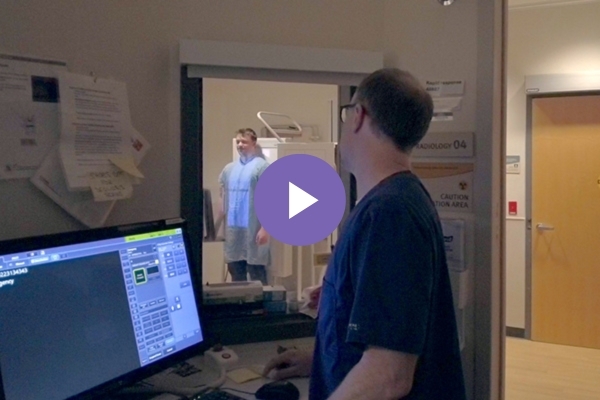
Click here to watch the video version of this story.
If you’ve ever noticed back pain that won’t go away, a change in posture, or a curve that just doesn’t look right, it’s natural to start asking questions. Is this normal? Is it scoliosis? And what do I do next?
With Salem Health, getting answers doesn’t have to be complicated. Scoliosis X‑ray screening is available on a walk‑in basis at Salem Hospital and West Valley Hospital, helping patients and providers understand what’s really going on, quickly and clearly.
Building a program around patients’ needs
Salem Health officially launched its scoliosis program in late 2024, expanding imaging capabilities to better support full‑spine exams.
As part of that launch, Salem Hospital and West Valley Hospital upgraded their imaging departments with specialized X-ray positioning backboards, plus added advanced stitching software designed specifically for scoliosis imaging.
“What this software does is it can take multiple images, because your spine usually fits on more than one image, and it stitches them together to form one image,” says Justin Millar, an imaging manager at Salem Hospital.
Even with that advanced capability, the exam itself is familiar and straightforward.
“It’s a simple X‑ray that uses just the advanced software to perform it,” Millar says.
Salem Health performed about 150 scoliosis X-rays in 2025, and its on pace for around 200 in 2026.
Who should get a scoliosis X‑ray?
Scoliosis screenings can be helpful at many stages of life. Pediatric patients may need imaging to monitor spinal development, while adults may be dealing with pain and posture issues or planning for surgery.
“A majority of our scoliosis X‑rays are either going to be pediatric or from neurosurgeons for surgical planning,” says Derick Tormey, a radiologic technologist at Salem Health.
But for many patients, the reason is much simpler: They just want to know what’s causing their pain.
“Is it scoliosis? Is it something that’s just your posture at work that’s causing this? Is it genetics?” Tormey explains.
Easy to access and complete
One of the biggest benefits of scoliosis X‑ray screening at Salem Hospital or West Valley Hospital is how easy it is to get done. You don’t need to wait weeks for an appointment.
“Since it is a regular diagnostic X‑ray, there’s no appointment needed,” Millar says.
Tormey sees that convenience mattering to patients every day.
“The screening is fairly quick, usually less than five minutes,” Tormey explains. “You’re in, you’re out. Take one or two pictures, and that’s it.”
And for those worried about discomfort?
“It doesn’t hurt,” Tormey says. “It’s just an X‑ray.”
What happens after the exam
After the images are taken, they’re prepared for review by a radiologist.
“Once the radiologist views those images and interprets the results, those will go straight to your ordering provider and to your MyChart account,” Millar says.
In most cases, patients don’t have to wait long.
“About two to three business days,” Millar says, sometimes sooner.
“They’ll know pretty quickly,” Tormey adds.
Getting answers helps people move forward
Whether it confirms scoliosis, rules it out, or points toward another cause, the goal of scoliosis screening is clarity.
“Patients just want answers, and we hope we can provide them with something that will give them an answer,” Tormey says.
And sometimes, having that information is the first step toward relief.
Thinking about a scoliosis screening?
If you or your child is dealing with back pain, posture changes, or concerns about scoliosis, start a conversation with your primary care provider. Ask them about a referral for a scoliosis screening X‑ray at Salem Hospital or West Valley Hospital.
With walk‑in access, quick exams, and results sent directly to your provider and MyChart, getting answers doesn’t have to be stressful, it can be simple. Learn more at salemhealth.org/imaging.