What is Dupuytren’s disease and how is it treated?
Jeffrey Knight, MD, is a hand surgeon at Salem Health Orthopedics. He often works with patients living with Dupuytren’s disease.
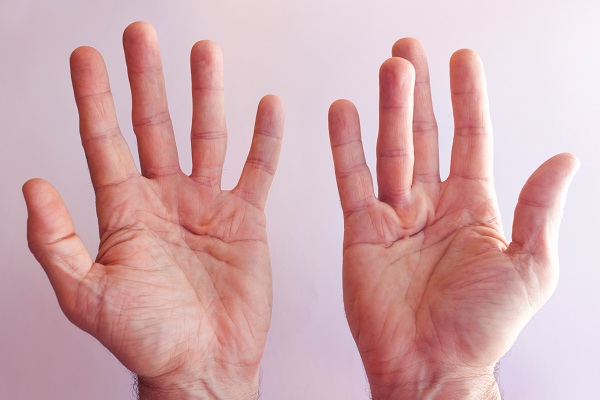
This is a genetic condition where the tissue under the skin of the palms and the soles of the feet can become contracted and form nodules or cords. It can skip family members and vary widely in severity.
Signs and symptoms
“Dupuytren's is usually not painful, and treatment is mainly directed at preserving or restoring function of contracted fingers,” said Dr. Knight. “Early disease with no contracted joints is best to just observe. Once the contracted tissue starts to impact motion in the fingers and affect activity, treatment can be considered.”
Dr. Knight said you should seek out medical care if the condition begins limiting your hand function or causing pain. Since Dupuytren’s is usually not painful, quickly seeking care to rule out other problems is important if pain arises.
“Rapid progression is a sign of severity,” he added. “It is easier to reverse when addressed early.”
Treatment to restore flexibility
“Treatment is usually beneficial once it’s reached a point where they cannot place their hand flat on a table,” he said.
Dr. Knight notes there is no treatment to prevent the progression of Dupuytren’s. However, the rate of progression varies widely from person to person.
Two less invasive options for treatment is injecting an enzyme that weakens the contracted tissue or breaking it up with a needle. Surgery can be used for more severe cases to remove the affected tissue and straighten the contracted finger joints.
Care at Salem Health
Are you dealing with challenges like arthritis or trigger finger? Salem Health Orthopedics has the largest group of surgeons in the mid-Willamette Valley specifically trained in treatment of hand and wrist conditions.
Click here to learn more about care with Salem Health Orthopedics.